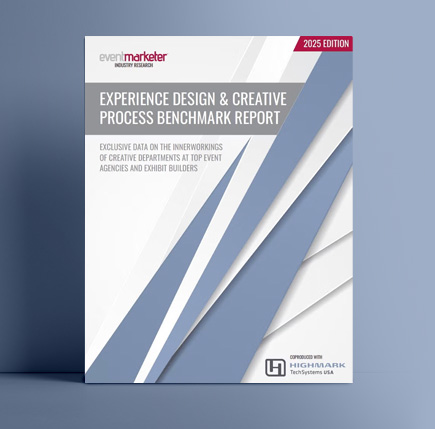
TLDR: The 2025 Experience Design & Creative Process Benchmark Report, produced by Highmark TechSystems and Event Marketer, reveals how top event agencies and exhibit builders are evolving. Creative departments are becoming more strategic, collaborative, and data driven. They’re blending design, technology, and measurable outcomes to shape the future of experiential marketing.
At a Glance:
- Creative departments are evolving strategically. Most teams remain lean but are investing in specialized roles like 3D and content creatives to drive impact.
- Integration defines the creative process. Collaboration between creative, strategy, and operations teams now drives faster and smarter execution.
- Technology and data dominate output. More than 60% of teams are using additional technology and analytics to measure engagement and refine design.
- AI enhances, not replaces, creativity. Most teams use AI for ideation, renderings, and presentations to improve speed and visualization while keeping a human touch.
The 2025 Experience Design & Creative Process Benchmark Report—co-produced by Highmark TechSystems and Event Marketer—offers a rare inside look at how creative teams at the nation’s leading event agencies and exhibit builders operate today.
This research unpacks how departments are structured, how work gets done, and how creative collaboration translates into stronger experiential outcomes.
The report draws from hundreds of creative professionals across the U.S., revealing clear patterns in structure, workflow, and technology adoption. It provides data and direction for agencies, builders, and brand partners aiming to sharpen their processes and elevate client experiences.
Below, we break down the major findings from the report and what they signal about where the experience design industry is headed next.
Department Structure: Strategic Growth Over Size
Creative departments across the experiential industry have matured. Rather than racing to grow headcount, most are recalibrating around strategy and specialization.
According to the report, 60 percent of creative departments are maintaining their current size, while 30 percent are expanding, targeting very specific skill sets.
The most in-demand hires are Creative Directors, 3D Creatives, and Multimedia/Content Creatives. This hiring focus points to a growing emphasis on storytelling, visualization, and digital experience design: roles that directly shape how audiences connect with brands in physical environments.
Time allocation also reflects a shift toward strategy and client partnership. On average, creatives spend 18% of their time on RFPs, 18% nurturing client relationships, and 11% on builds or activations.
Only 10% of time is spent on-site, underscoring how much of the creative process is translating ideas, data, and objectives into tangible experiences.

Source: Event Marketer/Highmark
What’s emerging is a creative department that’s more deliberate and business-oriented. The modern event marketing creative isn’t just sketching ideas; they’re building strategy, managing relationships, and working as an extension of the client’s brand team.
Creative Process: Integrated from Start to Finish
The hallmark of today’s creative process is integration. Every creative role—2D, 3D, multimedia, and interactive—touches multiple stages of ideation, design, and production.
The report found that every respondent contributes to at least one key output area, whether developing RFPs, building client pitches, or managing activations.
This level of integration signals how experience design has evolved. Creative departments no longer operate in isolation from strategy or production. Instead, collaboration begins early, often at the moment a brief arrives.
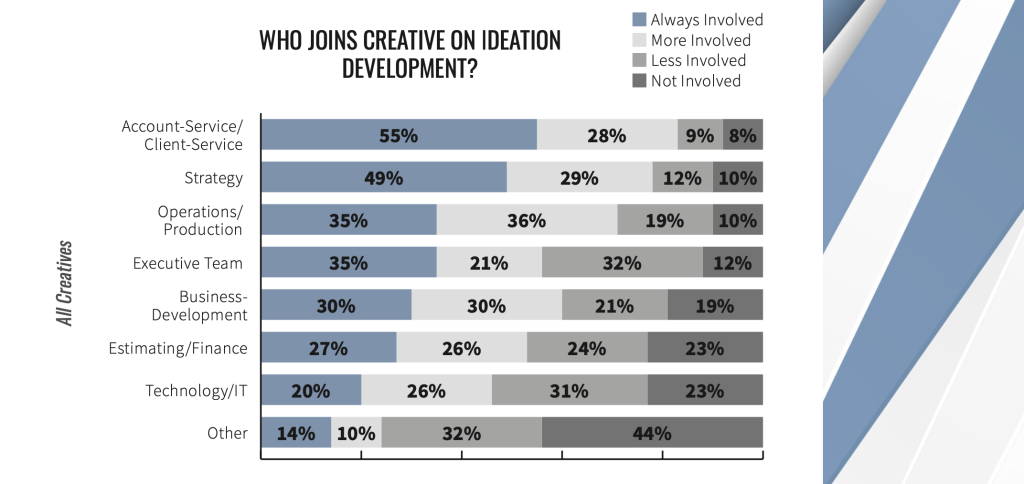
Account service and strategy teams are the most frequent partners in creative ideation, according to the data. These collaborations ensure that ideas are grounded in both brand goals and logistical realities.
Source: Event Marketer/Highmark
The result is a more holistic approach to experiential marketing: one that values speed, alignment, and clarity as much as creativity. When every stakeholder contributes to shaping the idea, the output is stronger and more feasible to execute.
This shift also helps teams better respond to the compressed timelines and budget pressures common in today’s event landscape. Integration reduces handoffs, improves consistency, and allows agencies and builders to deliver faster without sacrificing quality.
Workflow: Collaboration as a Competitive Advantage
Behind the scenes, creative departments are reengineering their workflows for efficiency and alignment. The report shows a clear increase in cross-department partnerships, particularly between creative, strategy, operations, finance, and executive teams.
These collaborations are how leading marketing and events agencies and trade show exhibit builders win business. Roughly half of respondents said operations and production staff now regularly join the creative process. Business development and executive leadership are also playing larger roles in creative discussions, bridging vision with value.
This deeper integration reflects an industry moving toward creative accountability. The strongest ideas today must balance design excellence with strategic return.
Agencies that connect creative teams to business metrics—cost efficiency, brand reach, audience engagement—are better positioned to meet client expectations and differentiate their proposals.
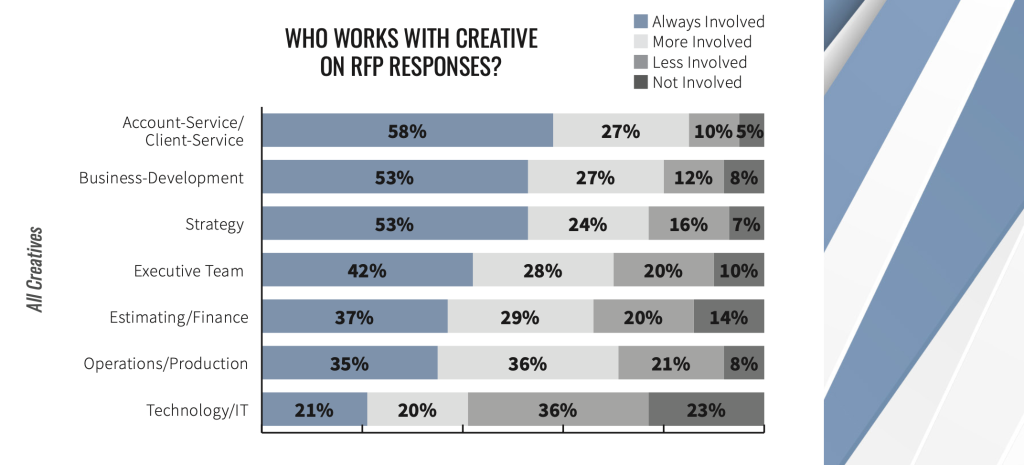
Cross-functional workflows also streamline RFP responses, one of the most time-intensive areas of creative work. With account, strategy, and design working in tandem, teams can produce more cohesive, compelling proposals…and move from concept to contract faster.
Source: Event Marketer/Highmark
Creative Output: Technology and Data Take the Lead
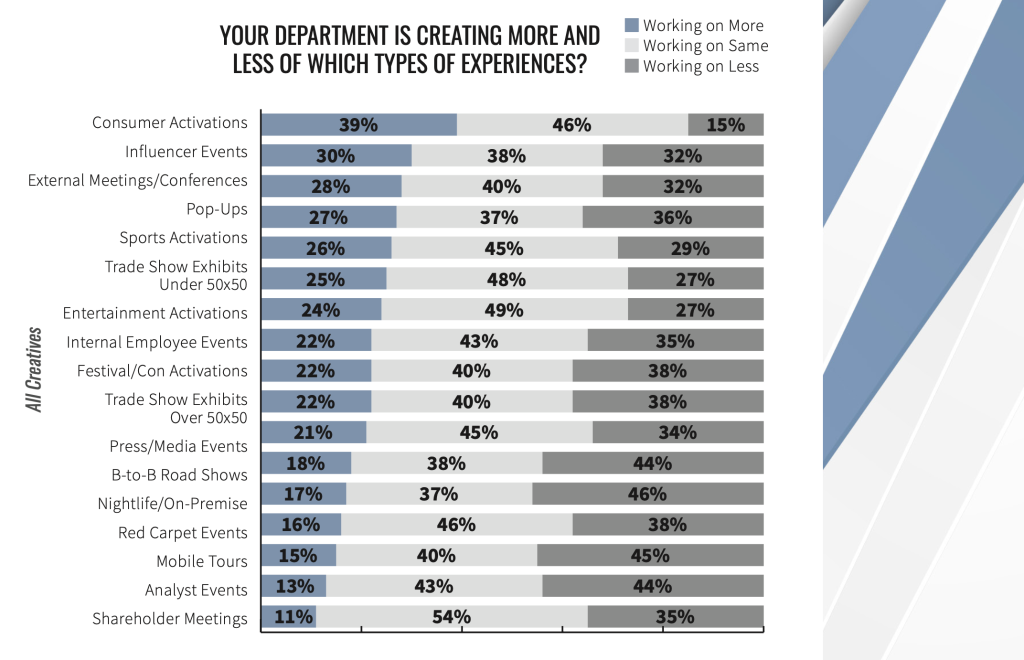
The work itself is changing. The most active experience categories in 2025 are consumer activations, influencer events, and external meetings and conferences.
Nearly half of agency creatives are working on more consumer activations this year, and more than 30% report increased demand for influencer events, external meetings, and pop-ups. These formats continue to dominate because they merge engagement, shareability, and measurable impact.
Source: Event Marketer/Highmark
Technology and analytics are the foundation of this new creative output. More than 60% of event marketing agency and exhibit builder creative departments report using more technology in experiences, while 57% have expanded measurement and analytics integration.
Social media amplification has also grown to 51%, showing how digital storytelling now extends far beyond the event floor.

Source: Event Marketer/Highmark
This focus on data and interactivity is reshaping what immersive marketing means. The strongest brand experiences combine physical design with audience insight, behavioral tracking, and real-time adaptability.
As brands demand more proof of ROI from live experiences, creatives are becoming data strategists as much as designers.
Artificial Intelligence: Enhancing, Not Replacing
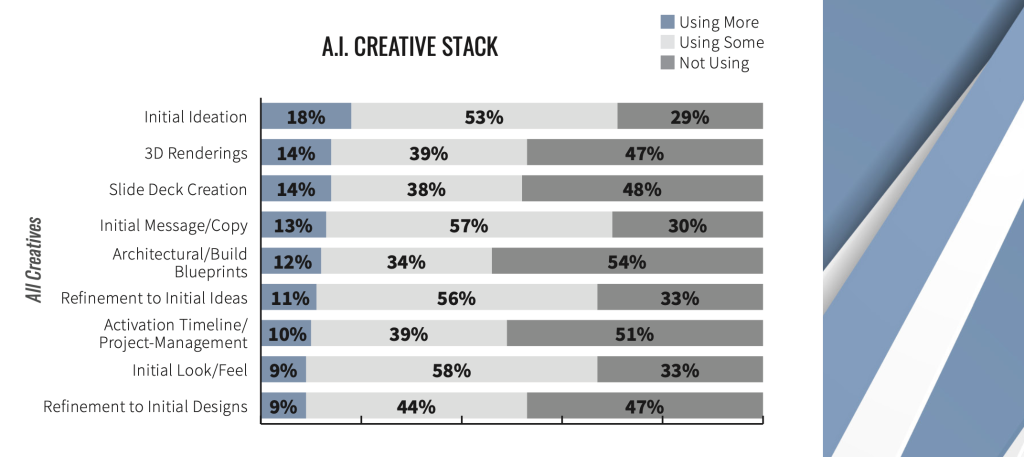
AI’s role in the creative process has moved from experimental to practical. Most creative teams now use AI in event design “some of the time,” primarily for ideation, 3D renderings, slide deck creation, and concept refinement.
Only about 20% of agencies use AI tools consistently, but nearly all have integrated them into parts of their workflow.
Source: Event Marketer/Highmark
Rather than replacing designers, AI is extending their capacity. It accelerates visualization, improves efficiency, and opens new avenues for concept development, particularly in early-stage brainstorming and rapid prototyping.
For experiential marketing agencies and exhibit builders, AI’s real promise lies in speed and iteration. Teams can now explore multiple design directions simultaneously, refine visual narratives faster, and bring clients into the creative process earlier.
As the technology matures, expect to see it increasingly applied to space planning, material selection, and even audience behavior prediction.
Partner with Highmark to Build What’s Next in Experience Design
Across the findings, one theme stands out: creative departments are becoming more disciplined and data-informed without losing their inventive edge.
The fusion of design, strategy, and analytics is giving rise to a more intelligent, agile approach to immersive brand experiences, and this evolution benefits brands as much as it does agencies and builders.
Highmark TechSystems is a leader in modular structures and experiential environments. Our custom systems give agencies the flexibility to design experiences that adapt to event marketing trends and create lasting impact.
If you’re a brand or event agency looking to explore the findings in this report, or want to discuss how Highmark structures can support your next interactive brand experience, connect with our team today.
FAQs
What is the Experience Design & Creative Process Benchmark Report?
It’s an annual study by Highmark TechSystems and Event Marketer that benchmarks how creative teams in the event marketing and exhibit design industries are structured, staffed, and evolving. Get a copy here.
What are the biggest event marketing trends for 2025?
The top event marketing trends 2025 include expanded use of AI, data-driven storytelling, cross-department collaboration, and measurable creative output tied to analytics and technology.
How is AI being used in event design?
AI supports ideation, visualization, and presentation work. It helps creative teams develop 3D renderings, refine concepts, and streamline RFP response materials.
What types of experiences are most in demand?
Consumer activations, influencer events, and live conferences are leading growth areas.
Why is collaboration so central to creative success?
As budgets tighten and expectations rise, collaboration between creative, strategy, and operations ensures ideas are both innovative and achievable.
How can experiential marketing statistics be tracked and leveraged?
Experiential marketing statistics can be tracked through a mix of digital and on-site metrics such as lead generation, social media amplification, dwell time, and post-event engagement. Creative teams use tools like QR codes, mobile apps, and analytics dashboards. When analyzed, they help agencies and builders refine design strategies, measure ROI, and create more effective, data-driven brand experiences.
Related Links
- Event Ops Episode One: The New Realities of Event Operations
- Event Ops Episode Two: Executing in a Complex Experiential Landscape
- Highmark TechSystems Recognized with Top Honors at the 2025 ExSys Awards
- Content, Conversations, and Connections for Agency Ops Teams
- Highmark Sustainability Statement
- Experiential Marketing
- All the Services Behind Highmark’s Modular Structures
- The Evolution of Highmark at EMS
- Why You Need Strategic Partnerships For Brand Activations
- Indoor Products
- Outdoor Modular Structures
- Mobile Events
- Products
- Resources
- Gallery
- Contact Us