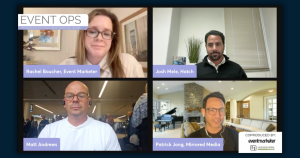
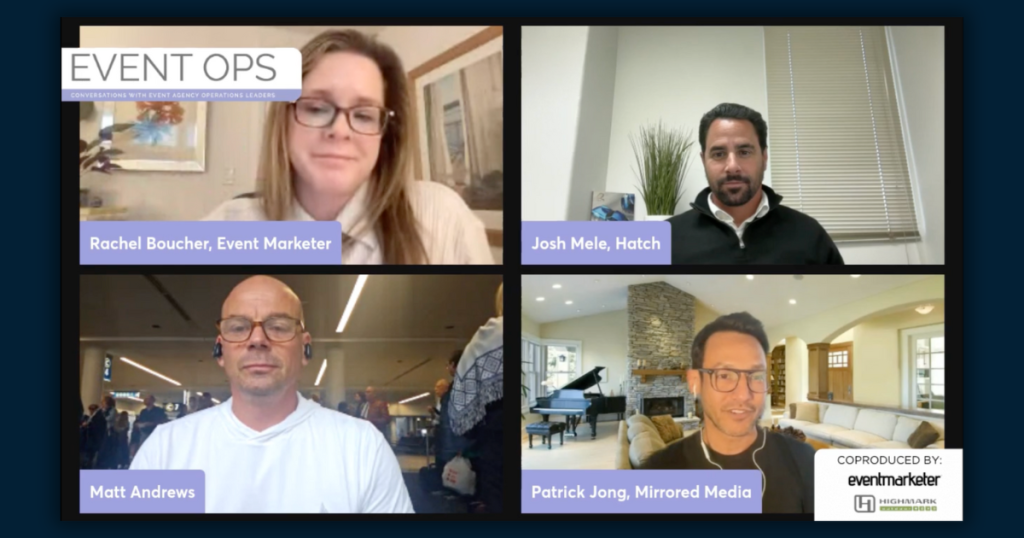
The fourth episode of Event Ops, Event Marketer’s LinkedIn Live series, focused on the nuts and bolts of executing large-scale experiential events. Rachel Boucher, Event Marketer Editor and Publisher, led a discussion with agency operations leaders:
- Patrick Jong, Director of Production at Mirrored Media
- Josh Mele, Co-Founder and Executive Vice President at Hatch
- Brian Baker, Vice President at Highmark TechSystems
- Matt Andrews, SVP at Highmark TechSystems
The conversation covered timelines, budgets, sustainability, and operational strategies for multi-level, complex experiences, highlighting how agencies and suppliers collaborate to execute at scale.
Here’s what they shared.
Bigger, More Complex Experiences
Experiential activations have grown in scale and complexity over the years. Mele observed:
“The productions are larger. Everything we are doing is more complex. The designs are bigger.”
This shift means operations teams are managing more moving parts, from larger custom builds to multi-location activations, all while keeping attendee experience front and center. Jong added that while creative ambition continues to expand, budgets don’t always keep pace:
“Our timelines are getting shorter…the dollars don’t stretch as much in some instances.”
Operations teams are increasingly being asked to do more with less runway, pushing teams toward smarter systems, resourcefulness, and deeper collaboration between agencies and suppliers.
The pressure to deliver measurable ROI has also grown. Brands want activations that not only wow audiences but also generate quantifiable engagement or lead data, requiring operations teams to think strategically about every element.
Managing Tighter Timelines
Short timelines are universal, and how teams manage them can make or break an activation.
Mele laid out the approach that works best for Hatch:
“Complete and utter blatant transparency of what’s possible and what’s not and what the costs are is the only way that we’ve successfully managed the short timelines.”
Meanwhile, Baker pointed out that on the supplier side, the right inventory can shave days or even weeks off a project:
“If you have a massive inventory of parts and pieces that are really versatile, you can deploy much more quickly.”
Andrews emphasized something many clients underestimate: sometimes installation windows matter more than fabrication windows. Both things inform how Highmark builds.
The message is consistent: shorter timelines require transparent communication, adaptable systems, and a shared understanding of what’s feasible.
Cost Control and Budgeting
Budgets remain tight across the industry, despite clients’ continued expectations for larger, more immersive builds. Jong explained that rising material and labor costs are forcing teams to think differently about how every dollar is spent:
“The dollars don’t stretch as much…we’re having to be a bit more creative and nimble at times.”
That pressure has reshaped how operations teams approach planning. Instead of treating budget conversations as a final step, they’re becoming part of the early strategic process.
Teams are evaluating the aspects of a build that directly impact the attendee experience and prioritizing those first, including branding moments, custom fabrication, scenic details, and any elements that influence how a space feels or functions for guests.
At the same time, they’re finding efficiencies behind the scenes: choosing materials that can be reused across multiple activations, relying more on modular systems, simplifying engineering where possible, and coordinating labor in a way that reduces overtime and last-minute crunches.
Sustainability in Experiential
Sustainability has shifted from a buzzword to an operational priority. Josh described how his time working with Disney shaped his philosophy, noting that their approach is grounded in consistency, training, and building habits that scale.
He doesn’t see sustainability practices as one-off fixes but part of a larger operational mindset. He also mentioned the importance of systems and training programs that reinforce sustainable behavior across every event.
Jong echoed the urgency of reducing waste in the industry:
“It’s such a wasteful industry, and we try to minimize that as much as possible.”
Andrews noted that Highmark’s modular structures inherently support sustainability:
“We’ve designed a system that can be reconfigured: change the size, change the look, change the options, but with predominantly the same stuff.”
By reusing structures, sourcing locally, and repurposing excess materials, operations teams can deliver memorable activations while reducing environmental impact.
Freelancers and Staffing
Finding the right talent continues to shape how experiential teams operate. Mele explained that the freelance landscape has evolved significantly, noting that freelancers now offer far more targeted skill sets tailored to specific types of activations:
“The people are a little more specialized. We see…a group of freelancers that are very good in the music festival space, that are very good in the high end beauty brand space, that are very good in the auto or gaming space, or whatever it is.”
That specialization helps agencies scale up quickly and match the right expertise to the right environment. Jong pointed out the flip side: as freelance opportunities grow, it becomes harder to maintain a consistently staffed internal team. Many experienced professionals now prefer the flexibility of project-based work:
“People want the flexibility to pick and choose the projects they want to work with.”
This shift changes how agencies plan for labor, particularly for large, multi-phase installations that rely on continuity, familiarity, and repeatable processes. Full-time staff provide stability and institutional knowledge, while freelancers bring specialized skills, but integrating the two requires thoughtful planning.
Operations leaders are navigating this balance by expanding their trusted freelancer networks, investing in internal training, and creating hybrid staffing models that ensure reliable leadership alongside flexible, event-by-event expertise.
Event Trends in Practice
The conversation wrapped with a look ahead to what’s shaping experiential work. Jong pointed to one clear shift: live experiences will “have a lot more artificial intelligence integrations,” with machine learning playing “a big part in events moving forward,” whether for metrics or guest interactions.
Andrews looked toward scale and ambition, describing next year as “big, beautiful, and outstanding.” With Highmark “doubling our inventory seemingly every year,” he expects “some awesome things…to happen,” especially as data shows the experiential sector continuing to grow.
Mele echoed Jong’s focus on AI but emphasized how data will guide decisions more precisely. Activations, he said, will become “a lot more…focused based on the information that they are getting from AI,” helping teams determine “this is worth this project and this one is not” and choose locations that deliver stronger ROI.
The takeaway: AI, analytics, and expanding modular capabilities are setting the stage for smarter, bolder, and more impactful live experiences.
Why It Matters
Event operations aren’t the flashy part of experiential marketing, but they shape every moment audiences interact with a brand.
Behind every smooth load-in, safe structure, and immersive experience is a team managing changing timelines, limited budgets, staffing complexities, and high creative expectations.
Smarter systems, stronger collaboration, and clearer communication are what make ambitious experiential work possible. Operations is where creativity becomes reality.
Key Takeaways for Event Marketers:
- Transparency prevents disaster. Clear communication about feasibility, costs, and timelines is critical.
- Versatile inventory speeds deployment. Modular, prepped structures allow agencies to respond to tight deadlines without compromise.
- Protect the visible experience. Budgets should prioritize elements that attendees can see and engage with.
- Sustainability is operational. Rentals, reuses, local sourcing, and waste management reduce environmental impact.
- Leverage specialized freelancers. Flexible talent fills gaps and brings expertise for niche activations.
- Data and AI drive smarter decisions. Analytics help optimize location, timing, and audience engagement.
Ready to Simplify Your Event Ops?
Highmark event structures are designed for efficiency, durability, and sustainability. From fully custom double-deckers to modular pavilions and mobile exhibits, our team helps agencies and brands deliver incredible experiences…even on the toughest timelines.
Connect with Highmark to see how our systems can keep your next event on budget, on brand, and on time.
Related Links
- Event Ops Episode One: The New Realities of Event Operations
- Event Ops Episode Two: Executing in a Complex Experiential Landscape
- Event Ops Episode Three: On the Frontlines of Live Events
- Debbie Parrott Featured in Exhibit City News
- A Look Inside Event Agencies’ Creative Processes
- Highmark TechSystems Recognized with Top Honors at the 2025 ExSys Awards
- Content, Conversations, and Connections for Agency Ops Teams
- Highmark Sustainability Statement
- Experiential Marketing
- The Evolution of Highmark at EMS
- Why You Need Strategic Partnerships For Brand Activations
- Indoor Products
- Outdoor Modular Structures
- Mobile Events
- Products
- Resources
- Gallery
- Contact Us