
TLDR: Double deck trade show exhibits are complex structural assets that require rigorous vendor evaluation across engineering credentials, code compliance, fabrication capability, and lifecycle costs. Buyers who understand the supply chain (and know what specifications to demand) make better decisions, avoid costly surprises on the show floor, and get structures that perform across multiple events.
At a Glance:
- Exhibit houses and structural manufacturers play different roles in the double deck supply chain. Buyers must know which layer of the stack their vendor occupies, because it determines who is accountable for structural specs versus show-floor services.
- A double deck’s load rating, materials specification, and engineering stamp are the three non-negotiable specs that should be confirmed in writing before any contract is signed.
- Starting vendor conversations months ahead of a target show date is what separates buyers who secure a properly engineered structure from those who settle for whatever can be delivered on a compressed timeline.
- A double deck exhibit’s true cost extends well beyond fabrication and includes storage, refurbishment, and freight across every show it attends.
Double deck exhibits are six- and seven-figure structural assets. They need to perform safely on a hard show floor deadline and then survive years of teardown, transport, and reconfiguration without compromise.
The vendor landscape makes evaluation harder than it looks. Exhibit houses, structural manufacturers, general contractors, and modular system suppliers all play different roles in bringing a double deck to the floor, and it is easy for buyers to compare quotes that are not actually comparing the same thing.
The decisions involved when you evaluate double deck exhibit manufacturers span structural engineering, compliance documentation, fabrication capability, and long-term lifecycle cost.
This guide walks through the criteria that matter most when selecting a provider for custom double deck structures, including the specific questions to put in front of any manufacturer before a contract is signed.
Understanding Who Builds What: Manufacturers vs. Exhibit Houses
The trade show industry operates on a layered supply chain that buyers often do not see clearly until something goes wrong. Exhibit houses (full-service agencies) typically handle design, project management, install and dismantle labor, and show-floor services.
The physical double deck structure, however, is often built by a separate structural manufacturer upstream.
A general contractor adds another layer: they manage venue logistics, labor coordination, and material handling within the show facility, but they do not engineer or fabricate the structure itself.
Knowing which layer of this stack your vendor occupies matters because it determines accountability. A vendor who subcontracts fabrication cannot answer structural questions with the same authority as the manufacturer who designed and built the system.
What’s the difference between an exhibit house and a double deck manufacturer?
An exhibit house is a design and service agency. It manages the client relationship, coordinates logistics, and often handles graphics, AV, and booth staffing, but it may not fabricate the structure in-house.
A double deck booth manufacturer is a fabrication entity. It engineers the structure, sources materials, manages production tolerances, and produces the stamped drawings that show management requires for approval.
Many exhibit houses source their double deck structures from manufacturers like Highmark and present them under their brand.
Ask any prospective vendor directly: do you fabricate the double deck structure in-house, or do you source it from a manufacturer? The answer shapes every subsequent conversation about specs, accountability, and lead time.
How do I know if my booth size and budget justify a double deck design?
Double deck exhibits make economic sense when a brand needs significantly more usable square footage than its footprint allows, or when the visual impact of a second level justifies the investment.
Many shows require a minimum 20×20-foot footprint (400 square feet) before a double deck permit is eligible.
Budget is the clearer threshold. A legitimate double deck trade show booth design evaluation should account for fabrication as well as show services since engineering, materials, installation, and logistics all factor into the total program cost.
Buyers working with more limited budgets are more likely looking at elevated risers or mezzanine-style platforms, which carry different structural and permitting requirements than a true double deck.
A useful early gut check is whether the booth footprint and projected traffic actually require an elevated and multi-level booth design or whether a lighter elevated element would deliver the same visual and functional benefit.
Structural Specifications That Matter
The structural numbers on deck are not marketing details; they are the double deck exhibit specs that determine whether the structure is safe, code-compliant, and approvable by show management.
Buyers should be asking about every item in this section by name, since double deck structural requirements vary by show, venue, and intended use case.
What weight load can a double deck exhibit floor support per square foot?
Double deck exhibit floors are typically engineered to support 40 to 100 pounds per square foot (psf), depending on the application. Standard occupancy loads for exhibit spaces generally fall in the 40–60 psf range, sufficient for personnel traffic, furniture, and light product displays.
Higher load capacity thresholds (75 psf and above) are specified when the upper deck will carry heavy equipment, demo machinery, or high-density foot traffic. Buyers should request the specific psf rating for any structure under consideration and confirm it against their intended use case, not just the manufacturer’s baseline spec.
Undersizing the load rating is a compliance risk and a safety risk. Show management will ask for this number during the approval process, and a structure that does not meet venue requirements will not be permitted to open.
Highmark’s ExpoDeck system carries a 125 lbs. per square foot active load rating, above the standard occupancy range, which gives buyers a useful benchmark when comparing competing proposals on this spec alone.
How tall can a double deck booth be at major trade shows like CES, NAB, and Exhibitor?
Height limits vary by show and by booth zone within the same show. Most major conventions, like CES (Consumer Electronics Show), NAB Show, and Exhibitor Live double deck structures at 20 to 24 feet total height, but specific rules differ.
Buyers should request the current exhibitor technical manual from show management before finalizing height specs with their manufacturer. Building to 22 feet for a show that permits 20 will result in mandatory structural modification at the exhibitor’s cost, on a compressed timeline.
What’s the minimum booth footprint required for a double deck exhibit?
Many major trade shows require a minimum 20×20-foot (400 square foot) footprint for a double deck structure. Some shows set the threshold at 30×30 (900 square feet) for upper-level enclosed spaces.
The footprint requirement exists because show management needs adequate clearance around the structure for emergency egress, fire suppression access, and sightlines to adjacent booths.
Smaller footprints concentrate structural loads and limit the staircase placement options that ADA accessibility compliance requires, but they may still be an option.
What materials are used in double deck exhibit construction, and how do they affect weight and durability?
Double deck structures are built primarily from aluminum extrusion, structural steel, or a combination of both. Aluminum is lighter (typically 30–40% lighter than equivalent steel framing) which reduces freight costs and makes reconfiguration more practical. Steel offers higher rigidity for very large or heavily loaded structures.
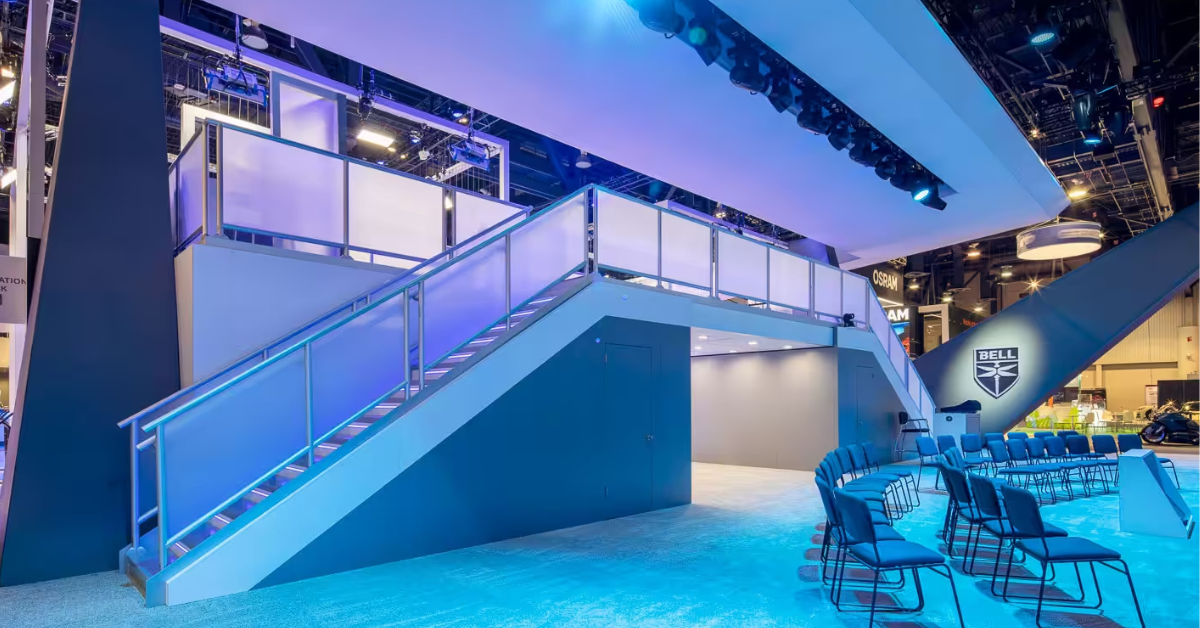
Decking surfaces are typically plywood with a hardwood or laminate finish, engineered for the specific psf load rating of the structure. Handrail and staircase components must meet building code minimums for height and spacing regardless of material.
Manufacturers using proprietary extrusion systems can offer modular reconfigurability: panels and connectors that adapt to different footprints across shows. Fully custom-fabricated steel systems offer fewer reconfiguration options but can achieve structural spans and design geometries that modular systems cannot.
Material specifications are where the difference between vendors becomes concrete. Highmark’s ExpoDeck, for example, fabricates its principal frame members from aluminum extrusions conforming to ANSI H35.2 Standard 6061 T6, with a minimum yield capacity of 35,000 psi and minimum tensile strength of 38,000 psi.
Structural bolts conform to ASTM A325 with 105,000 psi tensile strength. The system can span up to 20 feet in two directions, allowing for open, independently standing structures without intermediate support columns interrupting the design.
Buyers comparing manufacturers should ask for this level of material specificity.
What structural engineering stamps or PE certifications are required for double deck exhibits?
Every double deck exhibit requires a PE stamp (a certification from a licensed Professional Engineer) before show management will approve it for installation. The PE stamp certifies that the structure has been reviewed by a credentialed engineer and meets applicable load and safety standards.
The structural engineering certification must typically be jurisdiction-specific, meaning the engineer of record must be licensed in the state where the show takes place. A stamp from a California-licensed PE does not automatically satisfy requirements in Nevada or Texas.
Evaluating Structural Quality and Manufacturing Capability
The quality signals a manufacturer puts in front of you during a sales conversation are not the same as the ones that matter on the show floor. Here’s what buyers can verify before a contract is signed.
What certifications should a double deck exhibit manufacturer have?
Double deck booth certification at the manufacturer level is assessed across several dimensions.
Membership in the Exhibit Designers and Producers Association (EDPA) indicates industry standing and access to peer compliance standards. Compliance with International Association of Exhibitions and Events (IAEE) guidelines reflects familiarity with show floor operational requirements.
Beyond industry affiliations, buyers should look for manufacturers who carry commercial general liability insurance with per-occurrence limits appropriate to the scale of the structures they build.
How do I evaluate the structural quality of a double deck exhibit?
To evaluate the structural quality of a double deck exhibit, start with documentation requests: ask for load calculations, PE-stamped drawings, and the materials specifications sheet for a comparable completed project.
If an in-person review is possible, look at connection points and fastener specifications. Properly engineered double deck systems use hardware rated for the calculated loads, not general-purpose fasteners. Welds on steel systems should be uniform and fully penetrated.
Ask whether the manufacturer conducts load testing on representative assemblies. Load testing is not universally required, but manufacturers who do it voluntarily demonstrate a higher standard of quality control.
What signs indicate a double deck booth is over-engineered or under-engineered?
An under-engineered structure typically shows inadequate connection hardware for the span and load, handrails that do not meet minimum height requirements, and PE drawings that are vague on load assumptions.
Over-engineering usually appears as excessive material weight and cost without a corresponding structural justification. A 50×50 structure rated to 150 psf when occupancy loads will never exceed 60 psf represents unnecessary freight cost and fabrication expense.
The right structure is sized precisely for its intended loads with appropriate safety factors.
Compliance and Show Floor Approvals
Every major trade show has its own structural and safety approval process. The documentation your manufacturer must produce (and the timeline for producing it) determines whether your exhibit opens on time.
What fire codes apply to double deck trade show exhibits?
The NFPA fire code most directly applicable to trade show exhibits is NFPA 701, Standard Methods of Fire Tests for Flame Propagation of Textiles and Films. All fabric elements within a double deck structure (including ceiling panels, draping, graphic panels, and flooring materials) must meet NFPA 701 flame spread requirements.
Enclosed upper-deck spaces introduce additional requirements. Many venues and show managers require fire suppression systems (sprinklers) within enclosed spaces above a certain square footage threshold. The specific threshold varies by venue fire marshal jurisdiction.
Do double deck booths require advance approval from show management?
Double deck exhibits require advance show management approval at every major trade show. The approval process typically requires submission of PE-stamped structural drawings, materials specifications, and a site plan showing the structure’s location and orientation within the booth footprint.
What ADA accessibility requirements apply to double deck exhibits?
ADA accessibility requirements for trade show exhibits are governed by the Americans with Disabilities Act, with specific application guidance from show management and the venue. For double deck structures with publicly accessible upper levels, a compliant means of vertical access is required: typically a ramp meeting ADA slope requirements (maximum 1:12 ratio) or a platform lift.
Staircase-only double deck designs are permissible when the upper level is designated as non-public: private meeting space, storage, or staff-only areas. Buyers who intend to host general visitors on the upper deck should plan for compliant vertical access from the design phase.
What insurance or liability documentation is typically required for double deck structures?
Show management and venue operators typically require a certificate of insurance (COI) naming the show organizer and venue as additional insureds. Coverage requirements vary, but $1 million per occurrence and $2 million aggregate general liability is a common baseline.
Manufacturers should carry their own product and completed operations liability coverage, which protects against structural failures after installation is complete. Buyers should request and review the manufacturer’s COI independently, not rely on the exhibit house’s master policy to cover structural liability.
Some shows require a separate certificate for the installation contractor, which adds another documentation requirement the buyer must coordinate before move-in.
Cost and Investment
Double deck exhibits are a significant capital commitment. Understanding price ranges, the buy-versus-rent decision, and the cost variables that surprise first-time buyers helps procurement leads build realistic budgets before they go to RFP.
What’s the typical price range for a custom double deck exhibit?
Double deck exhibit cost for a custom build generally ranges from $150,000 to $500,000 for structures in the 400–2,500 square foot range. Very large or architecturally complex programs can exceed $1 million in fabrication cost alone.
Show services (installation, dismantling, drayage, and material handling) typically add $30,000 to $150,000 per show, depending on the city, the union jurisdiction, and the structure’s size.
Is it more cost-effective to buy or rent a double deck booth?
Buying is more cost-effective when the exhibitor plans to use the structure at three or more shows annually over a multi-year program.
Renting makes sense for one-time appearances, market tests, or situations where the exhibitor’s booth footprint changes significantly between shows.
Hybrid approaches (buying the primary structural system and renting supplemental components for larger shows) are increasingly common and can optimize capital efficiency for exhibitors with variable show calendars.
How do fabrication methods (modular vs. custom-built) affect double deck exhibit costs?
Modular fabrication uses proprietary panel and connector systems that can be assembled into multiple configurations. Modular systems typically cost 20–40% less than fully custom builds, carry lower freight costs due to standardized packaging, and can be reconfigured for different footprints without fabricating new components.
Custom fabrication produces a structure engineered specifically for a single design intent. Custom systems deliver design outcomes that modular systems cannot, but they carry higher upfront cost and offer fewer reconfiguration options after the initial build.
What ongoing costs should I budget for after the initial double deck build?
Storage costs, refurbishment between shows, shipping, maintenance, and transportation costs should all be budgeted in for your double deck build.
Timeline, Logistics, and Lifecycle
The operational realities of owning or commissioning a double deck structure extend well beyond the initial build. Buyers who plan for the full lifecycle make better sourcing decisions from the start.
How long does it take to design and fabricate a custom double deck exhibit?
Design and fabrication for a custom double deck exhibit typically requires 12 to 20 weeks from contract execution to completion, not counting the time required for client approvals and design revisions during the process.
Structural engineering and PE stamp production usually add 2 to 4 weeks on top of the fabrication timeline, and this work cannot begin until the design is finalized.
The buyers who consistently have the best outcomes start vendor conversations 6 to 9 months before their target show.
How long does on-site setup take for a double deck booth?
On-site installation for a double deck structure typically requires 3 to 5 days of move-in time, depending on the structure’s complexity, the labor jurisdiction at the venue, and how efficiently the structure is packed for installation sequence.
Union labor regulations in major trade show markets (Las Vegas, Chicago, Orlando, Anaheim) affect both the cost and the pace of installation.
Can a double deck exhibit be reconfigured for different booth sizes across shows?
Modular double deck systems are designed for reconfiguration, with panel and component inventories that support multiple footprint configurations from the same kit of parts. A modular system built for a 40×40 primary appearance can often be configured as a 30×30 or 20×40 for a secondary show.
Custom-fabricated systems offer more limited reconfiguration. Structural spans, staircase placements, and load-bearing elements are designed for a specific layout, and changing the footprint significantly may require new engineering review and additional fabrication.
How are double deck exhibits stored and transported between events?
Double deck structures should be stored disassembled, with components organized into cases, crates, and shipping containers sized for efficient packing. Proper storage organization significantly reduces installation time and labor cost at subsequent shows.
Transportation modes depend on geography and timeline. Ground freight is standard for domestic shows. International programs may require ocean container shipping and compliance with destination country import regulations.
Questions to Ask Before Hiring a Double Deck Exhibit Manufacturer
Use this checklist as a starting point for any RFP or vendor interview. Procurement leads who can get clear answers to all fifteen questions are in a position to make an informed decision.
- Do you fabricate double deck structures in-house, or do you source fabrication from a third-party manufacturer?
- What is the specific load capacity (in psf) of the floor system you are proposing, and what is your design load factor?
- Can you provide PE-stamped structural drawings from a comparable completed project?
- Do you have licensed Professional Engineers in the states where we exhibit, or do you coordinate with jurisdiction-specific engineers for each show?
- What are your standard submission timelines for show management approval?
- What NFPA 701 documentation do you provide for fabric and soft goods components?
- Do enclosed upper-deck spaces in your designs meet venue fire suppression requirements, and how do you confirm those requirements per show?
- How does your design accommodate ADA-compliant vertical access if the upper deck will be publicly accessible?
- What insurance coverage do you carry, and can you provide a certificate naming our organization as an additional insured?
- What is the total fabrication lead time from contract execution, and at what point in that timeline does structural engineering begin?
- What does on-site installation require in terms of labor hours, and which union jurisdictions have you worked in?
- Is the system you are proposing modular or custom-fabricated, and what reconfiguration options does that give us across shows with different footprint requirements?
- What are your standard storage terms, and how are components organized and labeled for reinstallation efficiency?
- What refurbishment is typically required between shows, and what is the cost structure for that work?
- What is your process when show management requests a revision to structural drawings after the initial submission?
Choosing the Right Partner
The double deck exhibit market runs on a layered supply chain that is not always transparent to buyers. Exhibit houses present structures to their clients, but the engineering and fabrication often originate with a structural manufacturer upstream.
Highmark TechSystems is that manufacturer.
The company engineers, fabricates, and produces PE-stamped documentation for double deck programs across the industry. The ExpoDeck system, designed and built to current International Building Codes (IBC), is a working example of what a fully documented, third-party engineered double deck product looks like in practice.
Exhibit houses and general contractors source custom double deck structures from Highmark and build their client programs on that foundation.
Buyers who have made it through this guide already know more than most procurement teams walking into a vendor conversation. The next step is putting that knowledge to work.
Reach out to Highmark to talk specs, get a real load rating, and find out what a properly engineered double deck actually looks like before you sign anything.
Related Links
- Why Leading Brands Choose Highmark TechSystems Event Structures
- All the Services Behind Highmark’s Modular Structures
- A Look Inside Event Agencies’ Creative Processes
- Why the Best Trade Show Meetings Happen Above the Show Floor
- Rental vs. Custom Double Deck Structures: What’s Best for Your Event Schedule?
- Double Deck Structure
- How to Take Your Trade Show to the Next Level, Literally
- Top 3 Advantages to Double Deck Exhibits
- Modular Structure Rentals
- Resources
- Gallery
- Contact Us