
TLDR: A US made double deck exhibit arrives dimensioned in the same feet and inches that US venues, show organizers, and freight carriers already use, which removes conversion work and wasted footprint. Highmark TechSystems builds and rents 20 standard ExpoDeck kits, ranging from 10×12 to 80×16, and ships them domestically from Fort Wayne, Indiana, so replacement parts sit days away instead of an ocean away.
At a Glance:
- US venues specify every dimension in feet and inches, so a deck built on imperial increments, like ExpoDeck’s 4 foot by 8 foot deck panels, fits the site without redraws or custom parts.
- Highmark TechSystems offers 20 pre-engineered ExpoDeck standard kits, ranging from 10×12 to 80×16, and every kit includes a downloadable spec sheet.
- Four factors drive the cost of a double deck exhibit: freight distance, standard versus custom fabrication, how many times you reuse the structure, and drawing conversion work.
- A domestic supplier can replace a part damaged during install in days, while an overseas supplier cannot get a replacement to you inside a fixed install window.
You have two ways to get double deck structures into US venues. You can source it from a manufacturer here, or you can bring one in from overseas. The renderings look about the same. The spec sheets and invoices don’t.
Three things separate a domestic deck from an imported one: the units the structure is dimensioned in, whether it lands cleanly on the footprint you actually have, and how far the steel has to travel before install day.
The advantages of double deck exhibits are endless, but where should you source them? Here’s what to know.
US Venues Are Measured in Feet, So Decks Are Built in Feet
In the United States, every dimension you receive for a build arrives in feet and inches, so a deck engineered in imperial increments fits the site without adaptation. That holds on a convention floor and just as firmly in a stadium or on a festival field.
Show organizers sell trade show space on a ten-foot grid, in footprints like 10×20, 20×20 and 20×30. Stadium operations teams, arena load-in crews, tent and pavilion suppliers, and freight carriers all quote their dimensions in feet too.
Whatever the site, the number somebody hands you is imperial.
Highmark TechSystems designs and fabricates ExpoDeck in house in Fort Wayne, Indiana, made in the USA and built to match.
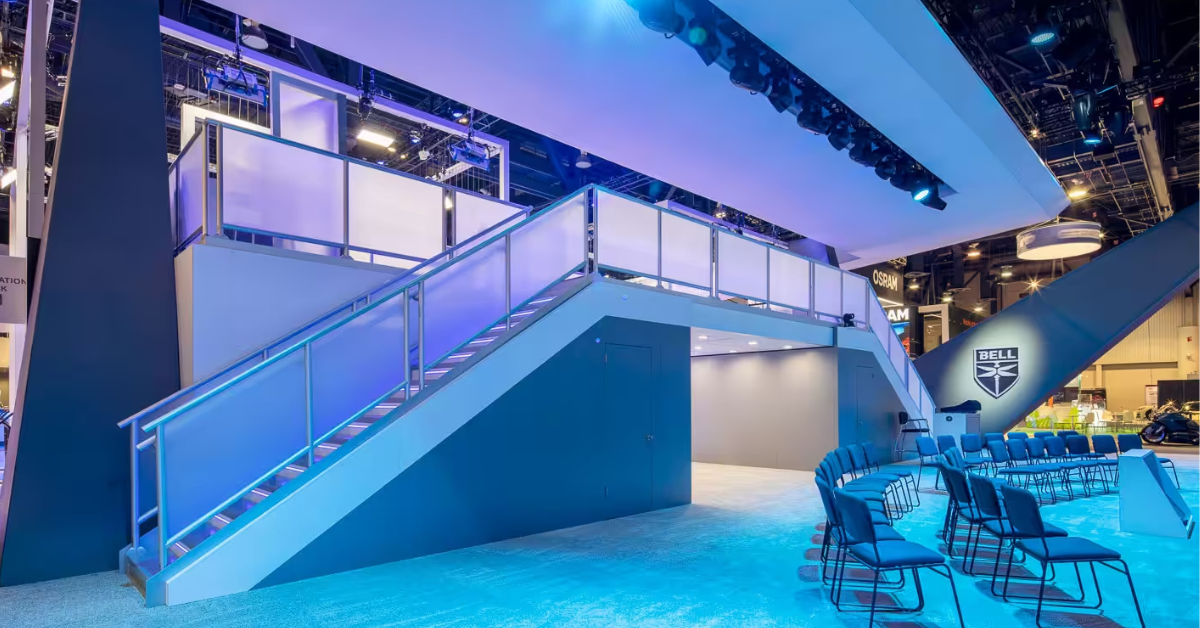
ExpoDeck’s two story exhibition stand design uses 4 foot by 8 foot deck panels and standard beams in 4, 8, 12, 16 and 20 foot lengths. Those increments build whole-foot structures that sit on a booth grid, a concourse plan or a fan zone layout without leftover inches.
An imported exhibition stand engineered on metric increments has to adapt to those dimensions somehow. That adaptation shows up as custom parts, a redraw, or footprint you paid for and can’t use.
Every drawing in a US build reads in feet and inches: the show management submission, the venue operations plan, the general contractor’s set, the fire marshal’s review. If your drawings start in metric, somebody converts them along the way, and conversions are where dimensions drift.
ExpoDeck at a Glance:
- Deck panel grid: 4′ x 8′
- Standard beam lengths: 4′, 8′, 12′, 16′, 20′
- Maximum span: 16′ unsupported, 20′ with columns, up to 30′ with custom components
- Active load rating: 125 lbs per square foot
- Typical occupancy: about 9 people with a single staircase under 300 sq ft
For full details, see ExpoDeck’s engineering specifications.
Standard Kits Do the Sizing Work Before You Design Anything
A standard kit gives you a pre-engineered, pre-drawn deck in a whole-foot size, so you skip the engineering round trip before design even starts. Highmark TechSystems publishes 20 pre-engineered ExpoDeck standard kits, ranging from 10×12 up to 80×16.
Every kit dimension is a whole number of feet. Each one lands on a trade show booth footprint or on the round-foot dimensions a venue gives you for a hospitality build or fan zone, with nothing to convert.
Every kit includes a downloadable spec sheet, most include a DWG model, and several include a 3DS MAX model. Your designer starts from real geometry, and your client sees a real deck in the rendering.
New to the grid? Show organizers sell booth space in ten-foot blocks, and your deck has to land inside the block you bought. If someone handed you a 20×20 and said a deck is an option, a kit probably already fits it.
Planning double decker exhibition stands for a US show and thinking in meters? Every one of the 20 standard kit sizes below comes in whole feet, so it matches the units US organizers and venues use. Highmark double deck exhibition stand design starts with geometry that already fits.
The 20 ExpoDeck standard kits: 10×12, 10×18, 10×20, 12×12, 12×16, 14×18, 16 Round, 16×16, 16×20 Quarter Round, 20×18, 20×20, 24×12, 24×16, 32×16, 32×32 L-shape, 40×16, 48×16, 48×16 with bridge landing, 64×16 and 80×16.
What Actually Drives What You Pay
Four levers move the cost of a double deck more than anything else: how far it travels, whether it’s standard or custom, how often it goes up, and how much conversion work the drawings need.
None of them shows up in a rendering. All of them show up on the invoice.
Distance the structure travels: Carriers price freight on weight and distance. A deck leaving Indiana and a deck leaving another continent aren’t the same line item, and the second one brings customs and port timing along for the ride.
Standard kit versus custom fabrication: A standard kit already carries its engineering and its drawings. A custom build adds design, engineering and fabrication time. Both make sense, and the deciding factor is how unusual your footprint is.
How many times the structure goes up: Cost per use drops every time you reinstall. That might mean a season of shows, a venue’s event calendar, a festival that tours several sites, or a semi-permanent build you reconfigure instead of tearing down.
A structure sized for one footprint and used once carries its whole cost on that one event.
Conversion and redraw work: Every drawing that needs converting between unit systems, or re-engineering for a US venue or permitting submission, costs somebody billable hours. Your schedule absorbs the delay.
For actual price ranges and the ongoing costs to budget after the build, see our complete guide to evaluating double deck exhibit manufacturers.
Freight Is a Cost, a Schedule, and a Risk
Double deck exhibit freight decides more than a shipping line: it decides whether a problem on install day costs you an afternoon or the whole event. Treat distance as a risk variable first and a cost variable second.
Highmark TechSystems ships every structure disassembled, in efficient segments, out of Fort Wayne, Indiana. You choose where it goes: your shop first for a test fit, or direct to the site. That test fit only works when the structure already sits in the country.
Here’s how we build and ship every double decker exhibition stand.
Install windows never flex. A trade show gives you roughly three to five days of on-site move-in. A stadium or arena build happens in the gap between events, and a festival announced its gate-open time months ago.
None of those windows leaves slack for a customs hold or a missed port date.
Now picture a damaged or missing component mid-install. A replacement out of Fort Wayne is a domestic freight problem you can solve in days. A replacement from overseas doesn’t arrive inside the window at all.
Lead time stacks, too. Design and fabrication for a custom double deck runs roughly 12 to 20 weeks from contract. International transit sits on top of that timeline, not inside it.
The freight and parts argument gets stronger when a structure stays up for months instead of days. Longer installs, like semi-permanent structures at stadiums, festivals, and other venues, give a part more time to fail. Your supplier’s distance decides whether that failure means a phone call or a shipping delay.
Rent or Buy: Domestic Inventory Decides How Fast You Get a Deck
Opt for modular structure rentals for occasional or single-event use, and buy when your calendar keeps a structure busy. About 70% of Highmark TechSystems clients rent.
Renting only moves fast when the inventory already sits in the country. Domestic stock makes a rental a rental, not an import with extra steps.
Comparing modular exhibit rentals in the USA? Learn more about the full comparison of rental vs. custom double deck structures.
What to Confirm Before You Sign
Five sourcing questions tell you more about a supplier than any brochure will. Ask them before the contract:
- Where does fabrication happen? Ask where the supplier fabricates the structure, not where it keeps its headquarters. Those answers often differ.
- Can I see the spec sheet and CAD file now? Get geometry before you commit. If a supplier can’t hand it over, your designer is guessing.
- What units will the drawings arrive in? Confirm they match what your show submission or venue permitting requires. A conversion you discover late becomes a redraw you pay for.
- What happens if a part fails during install? Ask how far away the replacement sits and how it reaches your site inside the window.
- Does a standard kit already fit my footprint? Check before you pay for a custom build. A 20×20 booth or a round-foot venue footprint often matches an existing kit.
For the full vendor checklist, see our complete guide to evaluating double deck exhibit manufacturers.
Choose the Shortest Supply Line
A double deck succeeds or fails on three things you can check before you sign. Does it fit the footprint? Do its drawings match the units your site runs on? Do its parts sit close enough to rescue a bad install day?
An American made double deck answers to all three by default. Imported double deck stands can get there too, but you pay for it in conversion work, lead time, and risk.
Start with the geometry.
Browse the 20 ExpoDeck standard kits, download the spec sheet or DWG for your footprint, and see what fits. Then talk to the Highmark TechSystems team in Fort Wayne, Indiana, about your site, your dates, and your install window.
Frequently Asked Questions
Do double deck exhibits in the United States use feet or meters?
US double decks are sized in feet and inches. The US build environment runs on imperial end to end. Show organizers sell trade show space on a ten-foot grid, and venues, load-in crews and freight carriers all specify dimensions in feet. ExpoDeck uses 4′ x 8′ deck panels and beams in 4, 8, 12, 16 and 20 foot lengths, which build whole-foot structures without conversion.
What are the size options for double deck structures?
Highmark TechSystems publishes 20 pre-engineered ExpoDeck rental kits, ranging from 10×12 up to 80×16. The range includes rectangular kits, a 16 Round, a 16×20 Quarter Round, a 32×32 L-shape, and a 48×16 with a bridge landing.
Do you need a US-made double deck exhibit for a US event?
No. US events use imported structures regularly. Domestic manufacturing changes the logistics, not the eligibility.
How much does freight add to a double deck exhibit?
It depends on weight and distance, since carriers price freight on both. The bigger difference is schedule risk. Domestic freight moves in days and can reroute. International freight adds ocean transit, customs clearance and port timing, none of which fit inside a fixed install window.
Where to buy or rent custom modular exhibit systems for rapid deployment?
Highmark TechSystems manufactures and rents ExpoDeck double deck structures out of its facility in Fort Wayne, Indiana, with 20 standard kit sizes available. About 70% of Highmark clients rent rather than purchase.
Is it better to rent or buy a double deck exhibit?
It depends on how many times you’ll use it. Roughly 70% of Highmark clients rent. Modular exhibit booth rental in the USA suits occasional or single-event use and takes storage and refurbishment off your budget. Buying makes more sense across a heavy annual calendar.
Who manufactures double deck exhibits in the United States?
Highmark TechSystems designs, engineers and fabricates double deck exhibit structures in house at its facility in Fort Wayne, Indiana. Its American-made double deck system, ExpoDeck, carries a 125 lbs per square foot active load rating and spans up to 16 feet unsupported, 20 feet with columns, and up to 30 feet with custom components. Ask us about the best elevated exhibit structure for a 20×20 trade show.
Can you use a double deck structure somewhere other than a trade show?
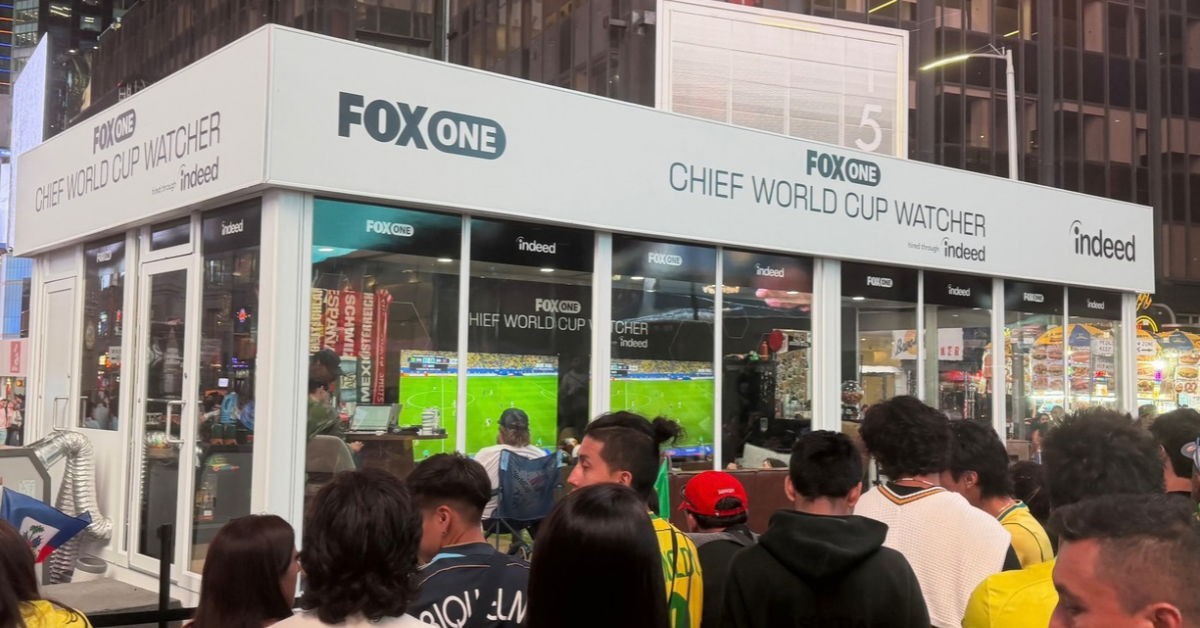
Yes. Crews install double deck structures at stadiums, festivals, and venue and hospitality builds, indoors and outdoors.
Related Links
- The Complete Guide to Evaluating Double Deck Exhibit Manufacturers
- Why the Best Trade Show Meetings Happen Above the Show Floor
- Rental vs. Custom Double Deck Structures: What’s Best for Your Event Schedule?
- Why Leading Brands Choose Highmark TechSystems Event Structures
- All the Services Behind Highmark’s Modular Structures
- Double Deck Structure
- Modular Structure Rentals
- Resources
- Gallery
- Contact Us